
The doorway was wide enough—and the turn was not
The tape measure had already declared victory. “Plenty,” somebody said, looking at the spare doorway space. Painter’s tape then supplied the missing hallway, and our confidence lasted about four seconds. The left footrest kissed the blue line before the chair had faced the bathroom. Door width had been measured perfectly; unfortunately, the room wanted an answer about arrival.
We now begin a power wheelchair turning radius discussion beside that sort of taped corner. Keep the factory figure on the model sheet—just pull up four more chairs for approach angle, fitted parts, nearby obstacles and the person holding the control. Then the number has company. Left alone, it is being asked to drive, which seems unfair to a number.
Give the specification a patch of floor
Nobody photographs our test kit before the chair arrives. Level floor, blue tape, two patient colleagues: that is nearly the inventory. We lay out the verified circle and then, slightly rudely, cut into it with a doorway and right-angle hall. The chair turns up wearing the parts that define its outline. If delivery will wear something different, the first line says so in handwriting large enough to spoil wishful thinking.
The driver takes the slow job. The observer takes the unfashionable view—the chair edges, not its centre. Front casters, feet, controller and the rear of the frame all receive attention. Forward entry comes first. Then a turn, a reverse correction and recovery from an approach that is deliberately a little untidy. Real users do not arrive at every doorway on a surveyor’s line.
No speed prize is offered, and nobody leaves with an accidental clinical assessment. We are watching this configuration borrow space from this layout—nothing grander. When a customer joins, the supervision and professional input follow that individual’s control, posture and safety needs. A power wheelchair turning radius test can inform a product-and-room decision; it cannot promote the showroom into a clinic.
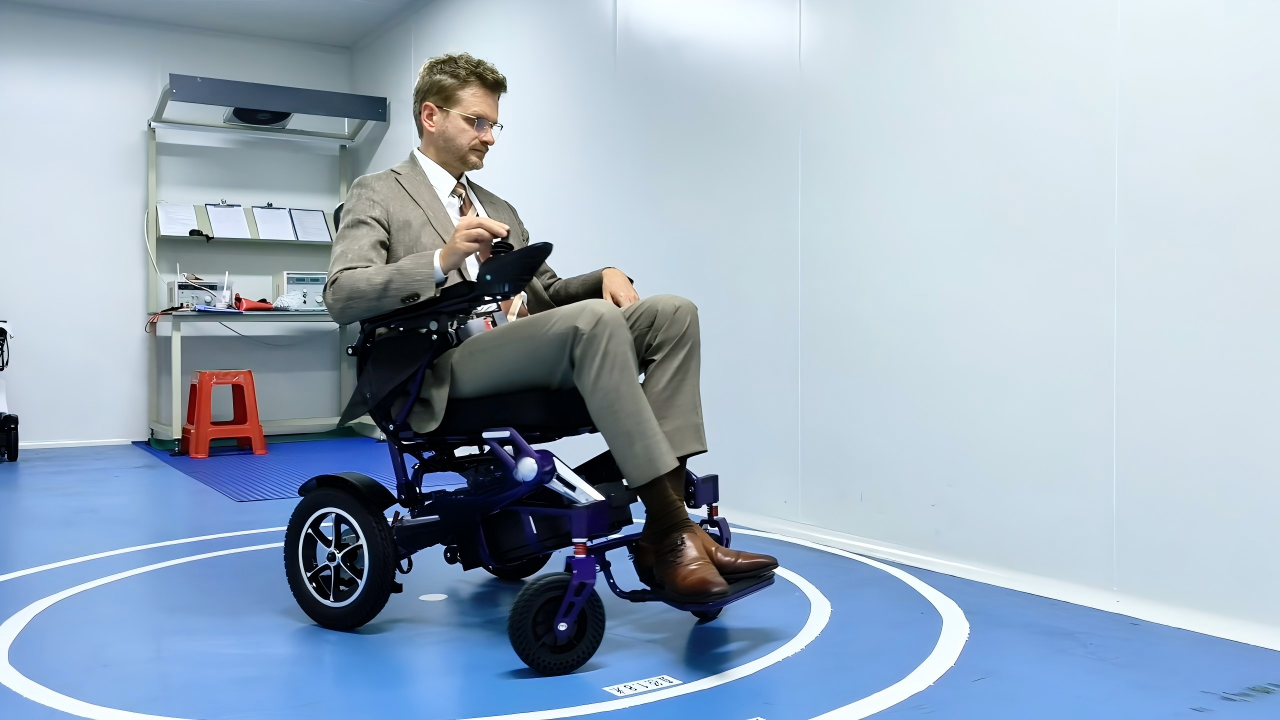
Watch the part that sweeps behind the driver
Eyes follow the doorway almost without asking. So the observer gets a deliberately backward job: watch the patch the chair is leaving. The front can behave beautifully while a rear corner wanders wall-ward or a caster reaches sideways into an apparently unused patch. Small cones remember those near points until the whole manoeuvre—not merely its prettiest half—has finished.
PASS and FAIL are lonely words on this record. We add the messy middle: clean entry or correction, one adjustment or three, and the chair part that came nearest the line. Could the driver repeat the move after the coaching stopped? Now power wheelchair turning radius has something useful to say to the next salesperson, rather than leaving a perfect circle beside a fading memory.
Floor conditions get their own caution. Tile lets the chair answer one way; deep carpet and a threshold may elicit another. A slope changes the conversation again. The result keeps the name of its surface, and any important missing condition returns to the test list instead of being covered by the word “similar.”
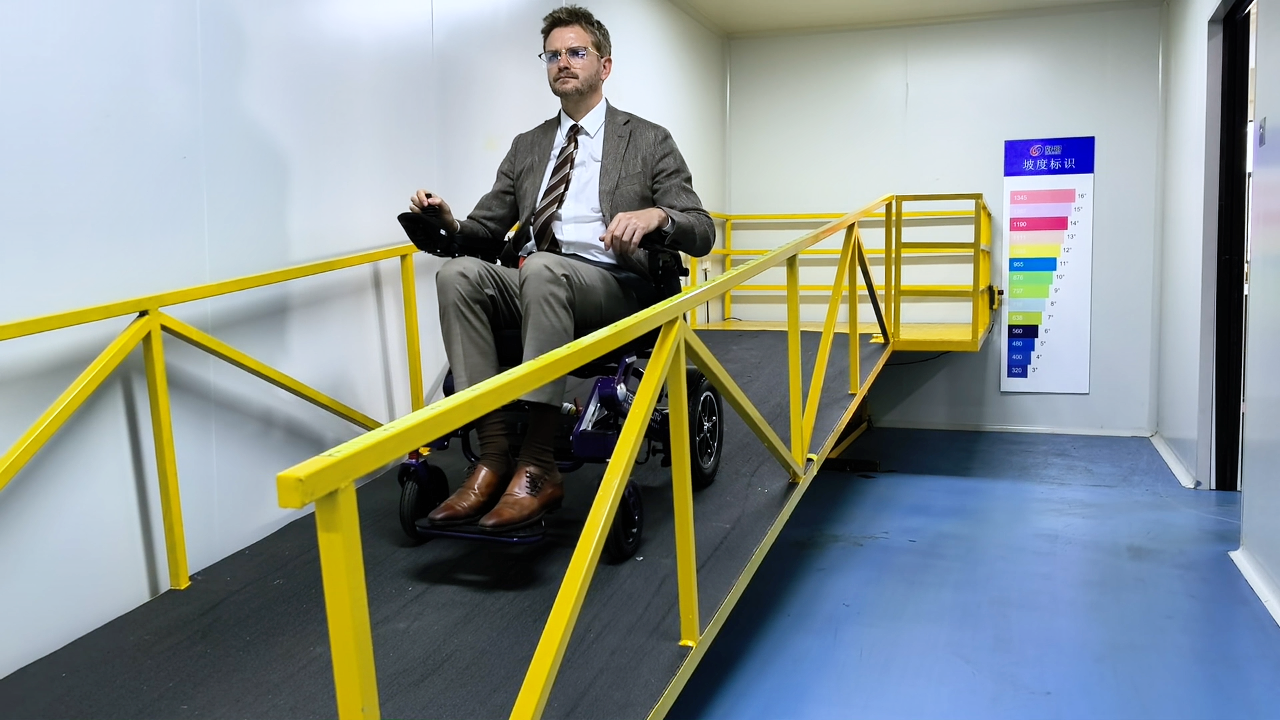
Photograph evidence without pretending it is a standard
A high view of chair and tape makes the first image. Next, the photographer stands where the hallway would be; the second frame gets an approach instead of another flattering portrait. The video is allowed to be clumsy. At low speed, its corrections stay in. The caption names model and setup; nearby words tell the viewer whether the number is radius, diameter, chair width or approach space.
Painter’s tape proves only what happened in this dealer test. It does not rewrite a building code, replace professional assessment or settle a project’s obligations. We put that boundary beside the image before the image grows an authority it never possessed.
Patterns from these tests travel to Baichen service support. Three repeated questions about the same sweep point may deserve a clearer diagram. Several dealers confusing radius with diameter deserve a renamed field. Power wheelchair turning radius becomes more useful when the test improves the next explanation, not merely the current sale.
Questions dealers ask
Does the tightest circle take the trophy?
Only if the rest of the day agrees—and it often has other ideas. Seating, control, stability, route, transport and service requirements remain in the selection even when one corner is exceptionally tight.
Can doorway width predict the turn?
Door width tells us whether straight passage is plausible. Hall depth and approach angle then arrive with obstacles and the chair’s front-and-rear sweep to decide the turn.
Should we test only the factory figure?
Use the verified figure as the starting point, then recreate the relevant approach with the delivered configuration. Record any difference between the test chair and the ordered chair.
Bring us the difficult corner
Send the exact model, intended configuration and a sketch or measurements of the route that worries the dealer. We can help organise the product information around a practical power wheelchair turning radius check. Review the relevant chair categories, then share the real layout through our enquiry page.
Post time: Oct-12-2026