
In Japan, the world’s most rapidly aging society, electric wheelchairs and scooters have long moved beyond the label of “medical rehabilitation devices.” They have become everyday mobility companions woven into the fabric of daily life. A recent Baichen overseas market research study took a close look at Japan’s age‑friendly mobility aids and found a product logic quite different from that of Europe and North America. Three key principles – narrowness, lightness, and precision – guide the design. These lessons from a neighboring country are now offering fresh inspiration for Baichen’s own product evolution.
1. Narrowness: Tailored to the “Minimum Passage” of Japanese Homes and Public Spaces
Standard door widths in ordinary Japanese homes range from 70 to 75 cm (the traditional “1.6 shaku” measure). In rental apartments and senior housing, they can be as slim as 65 cm. By contrast, a typical Western wheelchair is 65–68 cm wide, and with armrests the actual clearance needed exceeds 70 cm – making indoor movement in Japan very difficult.
As a result, the Japanese market has strict requirements for maximum wheelchair width. Mainstream models keep overall width between 58 and 62 cm. Armrests can flip up or retract inward, saving an additional 10–15 cm of lateral space. Moreover, many public facilities – subway ticket gates, convenience store entrances, accessible restroom stalls – are designed around a 60 cm baseline, expecting wheelchairs to go “straight in and straight out” without turning sideways or reversing.
Following these Japanese standards, Baichen’s design team has produced a new aluminum alloy wheelchair (launching in 2025) with a frame width of just 59 cm. It also features a one‑touch quick‑release armrest that can be completely removed in under three seconds, allowing passage through openings as narrow as 55 cm. During trial sales at Japanese dealerships, user feedback reported a 70% improvement in navigating tight spaces.
2. Lightness: Meeting the “One‑Handed Carry” Need of Female and Elderly Caregivers
In many Japanese households, the primary caregiver is a spouse over 65 or a middle‑aged to elderly woman – people with limited physical strength. Hence, the Japanese market is extremely sensitive to the “storage weight” of an electric wheelchair. Not only must the whole device be light, but each disassembled part should weigh no more than what a woman can comfortably lift with one hand (typically ≤8 kg).
Leading Japanese brands often use a “separate frame, battery, seat” design: main frame 12–14 kg, battery module 2–3 kg, seat cushion 1–2 kg. Users can carry these pieces in three trips, easily storing them in a Kei car trunk or a hallway cabinet.
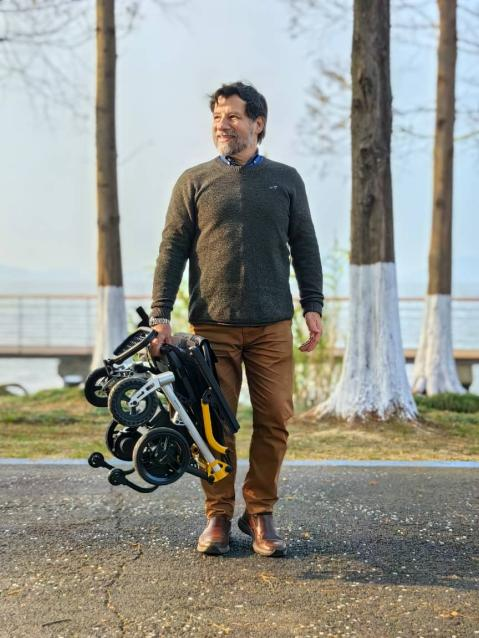
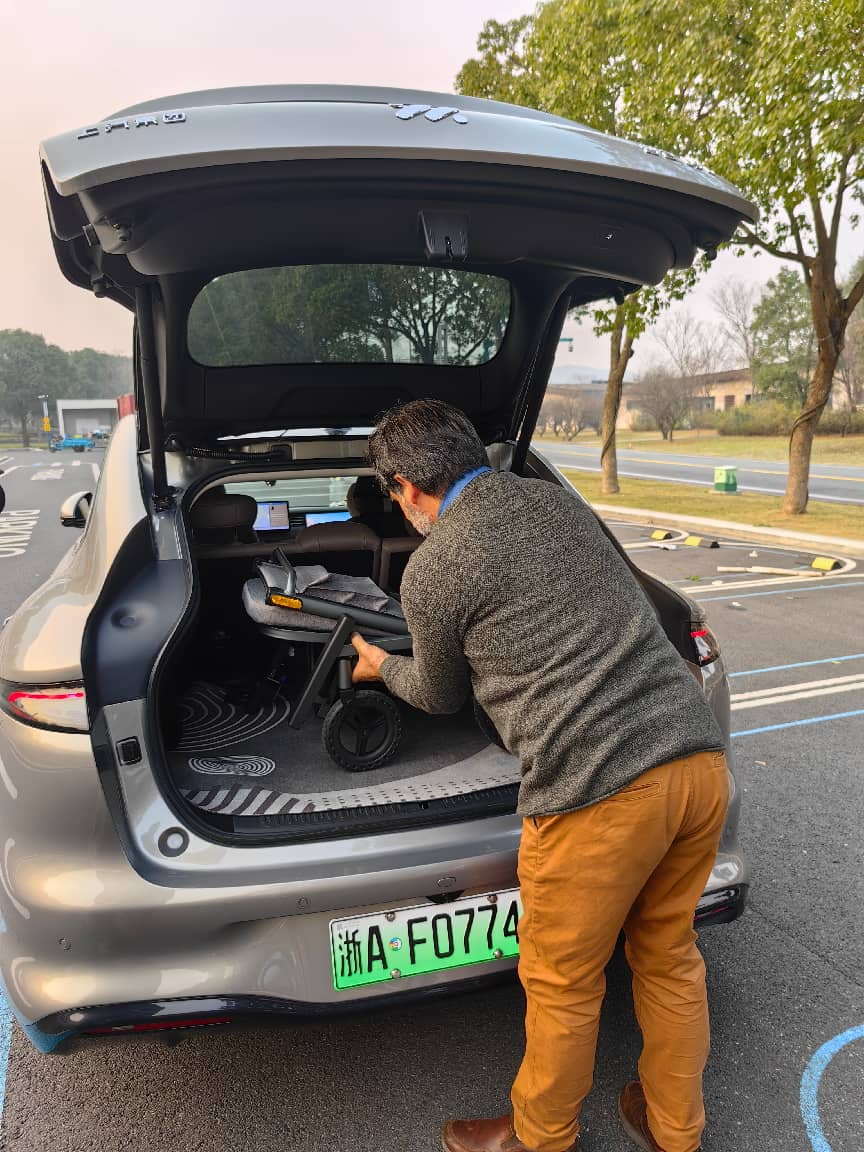
Drawing on this concept, Baichen has developed a “three‑part modular” structure based on its existing carbon fiber folding series. The seat cushion, battery box, and main frame are independent and quick‑release. The heaviest part – the main frame – weighs only 12.5 kg. With standard portable roller wheels, it can be pulled along like a suitcase on flat ground, eliminating the need to bend and lift. Patent applications for this design have been filed in both China and Japan.
3. Precision: Maneuvering Finesse for Seamless Subway and Bus Transfers
Japan’s public transit is very wheelchair‑friendly, but it demands extremely precise control. For example:
Platform gaps – Some older train lines have a 3–5 cm horizontal gap between the car and platform. The wheelchair’s front wheels must engage the gap at the right angle to avoid getting stuck.
Boarding ramps – Bus ramps are often only 50–60 cm wide, requiring a straight‑line approach with lateral deviation under 2 cm.
Elevator buttons – Elevator buttons are usually mounted 90–100 cm high and closely spaced, needing millimeter‑level joystick adjustments.
To meet these challenges, high‑end Japanese wheelchairs often feature a “turtle mode” (max 2 km/h) and non‑linear joystick response (a small push yields only 5% power). Baichen’s engineering team has pushed out “Japan‑specific firmware” via OTA update to its S‑Series wheelchairs sold in Japan. This adds a “Train Boarding Mode” that reduces joystick sensitivity by 60% and shortens electronic brake delay to 0.1 seconds, letting users handle platform gaps and narrow ramps with confidence.
4. Human‑Centered Details: From “Toe‑Flip Footrests” to “Night Reflectors”
What often moves users most in Japanese age‑friendly design is not the technical specs but the small, thoughtful touches:
Toe‑flip footrests – Users can flip the footrests upward with a toe touch, no bending required.
Night reflective strips – Japanese law requires that wheelchairs used at night have yellow or orange reflectors on the sides and rear.
Baichen’s Japan‑edition wheelchairs now come standard with all these details. The spring‑assisted toe‑flip footrest needs only 1 kg of force, greatly reducing lower back strain.
Baichen in Action: Learning from Japan to Enrich Global Design
Because of its extreme space constraints and demanding users, the Japanese market is a proving ground for truly human‑centric wheelchair design. Baichen has spent years tracking the usage logs of 50 Japanese households. By 2026, Baichen plans to introduce three proven technologies – the narrow body frame, the modular transport structure, and turtle mode – into its product lines for Europe and Southeast Asia.
We believe that truly excellent age‑friendly mobility tools should slip easily through every narrow door, roll smoothly over every threshold, and quietly accompany every journey. Baichen will continue to refine its products with a global vision, so that “Intelligently Made in China” wheelchairs carry the same ultimate human warmth.
If you are interested in Baichen’s custom products, please visit the Baichen official website.
Ningbo Baichen medical Devices Co.,LTD.,
+86-18058580651
Service09@baichen.ltd
www.bcwheelchair.com
Post time: May-23-2026